

opinion games single source: the Goo Deer page on Steam
Goo Deer: The Scoreboard That Pays For Defeat
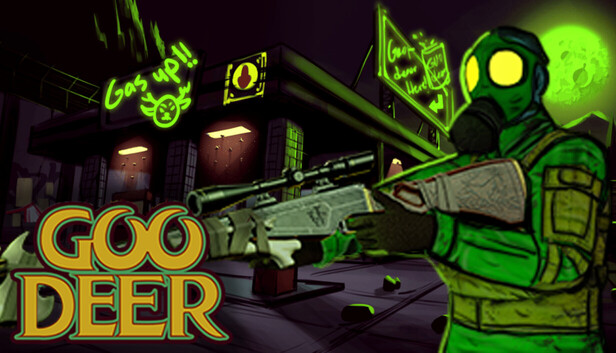
The atmosphere in Goo Deer is undeniably potent. The lore woven into the forest, the sheer evocative power of the setting—these are the strongest elements, the undeniable heart of the experience. Yet, when you peel back the veneer of this rich, moody simulation, you find a structural dishonesty at its core.
The game presents itself as a complex narrative challenge, a delicate balance of management and survival, but its endgame logic is fundamentally rigged to reward avoidance over completion. The scoreboard, in this case, is not a measure of skill; it is a ledger that pays for defeat and charges for victory.
The statistical landscape confirms this perverse incentive structure. Progression is tracked across three duration-based tables—Total Money Earned, Days Survived, and Products Sold—with no metric for outright completion. Steam data quantifies this systemic avoidance: 32.1 percent of owners have been killed by the Deerman, while only 6.2 percent have managed to dispatch it, and a mere 7.9 percent have achieved thirty days survived.
The achievement system caps at fifteen due to mutual exclusivity between killing or being killed by the Deerman in a single run; nine of ten rows on the days table conclude with being killed by it, cementing attrition as the dominant mode of operation.
The subtle implication of free access demands to be addressed within the texture of the argument itself. To leave that acknowledgment relegated to footnotes is to treat the transaction as mere administrative noise, whereas it is precisely the framing device here. The freedom granted to test this system—to interact with its mechanisms outside the standard commercial pressures—only serves to sharpen the focus on its innate biases.
By providing a key before the wider consumer base has processed the mixed signals from those initial twelve reviews, we are observing a microcosm of how early adoption pools influence perception. Furthermore, when reviewing outcomes generated from such privileged entry points, we must acknowledge that the resulting dataset is structurally suspect; it begins biased toward validation, however slight that slant appears among the subsequent fifty-two entries.
The game’s mechanics demonstrate an inherent preference for managed attrition over explosive triumph, and this preliminary sample size suggests that even when insulated from market scrutiny, the underlying design favors slow burn survival over decisive conquest.
To understand this imbalance, one must first grasp the grind. Players manage a roadside shop selling "Goo Deer," a beverage made from hunted carcasses. Daily life involves scanning inventory, handling cash flow at the register—a physical barrier locking the player in place—crafting flavors in a basement workshop, and upgrading machinery.
Customers add pressure late at night; unhappy patrons might raid the store requiring fistfights to repel them before closing time hits. This constant managerial loop consumes time relentlessly.
The necessity of hunting pulls players into the dense woodland behind the station using a bolt-action rifle. Here lies the first major constraint: deer do not inhabit the sprawling map randomly; they cluster tightly within just three specific zones. Exploration quickly becomes moot once these hotspots are exhausted.
Hunting requires precision: one body shot causes bleeding out; only a headshot guarantees instant death on impact. Ammunition is scarce early on, making every round precious currency against scarcity itself.
But hunting is governed by paranoia amplified by poor design choices regarding detection. Deer possess an enormous detection radius; they flee instantly upon sighting or hearing sound anywhere on their periphery. Sneaking is effectively impossible given this hypersensitivity.
True mastery emerges not from aiming perfectly, but from circumventing sightlines entirely—using carefully placed traps along rocky paths bordering rivers or strategically cornering animals against map edges until they have no choice but to run into your prepared firing lane. Upgrades become crucial pivots here; securing a rifle scope transforms hunting from pure chance into calculable geometry against this massive sensory field.
Eventually, acquiring the Operator upgrade allows automation of goo processing, freeing up vital hours lost to repetitive labor—though only about 30% of players ever make that investment in escaping tedium altogether.
This cycle culminates in confrontations with threats both mundane and mythical. Beyond routine depletion rates come local hazards like customer bottlenecks or inexplicable doorway jams while hauling supplies—procedural friction compounding systemic stress. Then there is the Deerman: appearing nightly past certain milestones as an apex predator capable of one-hit killing campers at spawn points.
While brute force often fails against it initially, defeating it requires meticulous daytime preparation of specialized rounds followed by patient nighttime ambushes from positions dictated by its own collision box limitations. Success hinges on completing this entire sequence flawlessly enough to earn bragging rights or reach arbitrary longevity thresholds displayed on leaderboards tracking total earnings or days survived—metrics focused solely on duration rather than decisive action.
The central mechanism shifts dramatically upon securing the core upgrades. The Deerman ceases to be a climactic confrontation and morphs into a scheduled event. Victory is redefined; it is not about slaying the beast, but about engineering one's own perfect termination.
Players become strategists of surrender, queuing not to survive until dawn, but to meet the creature during its nightly circuit, allowing that final, designated blow to serve as the entry vector for their highest score. Dying is indeed the functional equivalent of hitting submit.
This shift in definition deserves more than a passing nod to procedural maneuvering. The transition from active combatant to strategic facilitator of demise is perhaps the most chilling aspect of Goo Deer's design philosophy. It moves beyond simple difficulty scaling into something akin to performative resignation.
The pursuit of maximizing duration—of stretching out within those meticulously bounded operational parameters—becomes the ultimate signifier of competence. It implies that true genius in this environment is not demonstrated by overpowering adversity but by achieving optimal synchronization with its programmed limits. One learns not how to win against the system, but how gracefully to fulfill its requirements for longevity until it deems submission inevitable or sufficiently aesthetically pleasing for logging purposes.
This disparity forms the crux of our analysis concerning narrative ambition versus mechanical reality. Victory—dispatching that primal threat—is presented as a grand objective worthy of epic struggle; yet mechanically, that path remains statistically prohibitive for most entrants compared to simply maintaining operational equilibrium through efficient avoidance tactics across those limited foraging zones and mitigating low-level attrition risks indefinitely outside those danger pockets.
The leaderboard solidifies this perverse incentive structure perfectly: highest scores aren't claimed by conquerors, but by survivors who mastered bureaucratic stamina over dramatic prowess.
The difficulty slider is confirmed as functionally cosmetic regarding deep mechanics. It affects only initial resources; both Normal and Hard funnel into a single scoring metric on the shared leaderboard, rendering any advertised distinction moot in practice.
This speaks to an ethical tension far deeper than typical patch notes suggest about accessibility versus meritocracy within digital spaces themselves. When mathematical survival becomes significantly easier than spectacular success due to hardcoded choke points—the rigidity of the system creating inescapable pressure points, the system stops testing authentic ability and starts measuring patience against built-in bias favoring retreat over commitment.
The verdict cannot settle neatly onto a single rating point because its essence resides in this profound contradiction: Goo Deer boasts a richly textured shell—its lore breathing vibrant life into its desolate woods—but beneath that exterior runs an inherently cynical engine prioritizing sustained endurance over meaningful accomplishment or narrative resolution achieved through direct engagement with its greatest dangers.
It functions as a simulation where optimizing success means actively learning how best not to engage with its primary drama; where ultimate winning is merely remaining safely invisible to failure’s definitive tally mark on the board before resources deplete or fatigue sets in permanently via permadeath penalties layered atop performance strain from ordinary hardware usage.
Ten hours inside that clockwork cage leaves us feeling viscerally drained, though perhaps not defeated in spirit. The atmosphere is undeniably potent; it wraps around you like damp cloth and dictates a strange internal tempo almost immediately. That introductory hour, before the automation takes hold and routine settles in, possesses a genuine spark—a promise of chaos ready to bloom.
But once that initial novelty fades and the loop tightens into predictable maintenance cycles, the excitement curdles into tedium. Goo Deer isn't simply flawed; it's deeply compromised by its own architecture—a beautifully constructed machine demanding absolute commitment while simultaneously rewarding a highly specific, preordained path toward elegant collapse.
For those seeking pure struggle against unknown variables, this feels like an elaborate tease. But for those willing to engineer their descent according to an unseen algorithm, it offers a strangely meticulous performance piece worth watching through to its intended quiet end.
---
Disclosure: VML Studios approached this show about Goo Deer and provided a copy at no cost, before this episode was recorded. No agreement was made about how the game would be assessed; the studio had no involvement in the final content and saw no part of it before it went out. The game was played by our publisher, whose notes form the basis of this examination. Where the game is good this says so, and where it is not, the same.
← all posts
Comments
Loading comments…