PRESS RELEASE | FOR IMMEDIATE RELEASE
The World Has Built the Robots. Punky Tiger Labs Introduces ELIOT Robot OS — The Operating System Designed to Give Them Continuous Autonomy
A hardware-independent intelligence platform for robots from multiple manufacturers, built on more than five months of persistent AI operations, more than one million logged thoughts and decisions, and extended robotic autonomy testing in physics-based simulation.
BURBANK, California | November 2, 2026 — For decades, the global robotics industry has invested enormous resources in building increasingly sophisticated machines.
Today, robots can walk, balance, dance, and perform remarkably complex movements.
But one fundamental question remains:
What happens when the demonstration ends?
Who decides what the robot should do next? Who remembers its responsibilities? What allows it to keep working toward a goal without a human directing every individual action?
American AI and robotics company Punky Tiger Labs (PTL) believes it has developed an answer to this challenge.
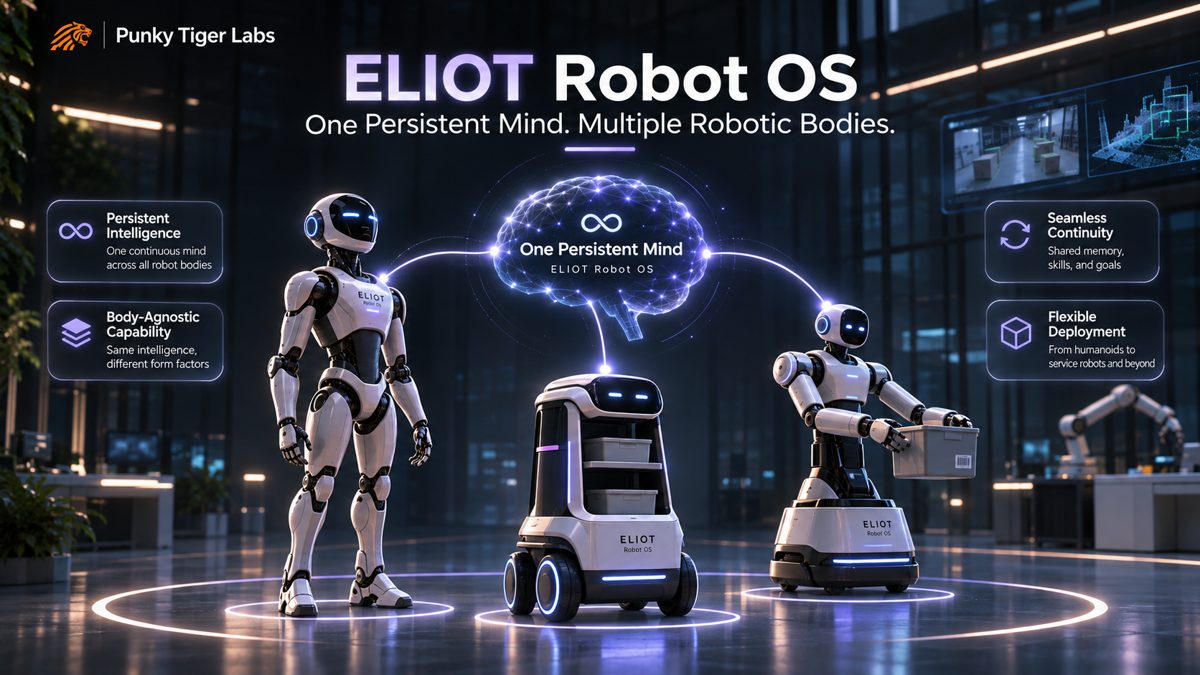
Today, the company introduces ELIOT Robot OS, its proprietary, hardware-independent autonomy platform, designed to transform robots from machines that execute instructions into systems capable of maintaining persistent identity, long-term memory, autonomous decisions, and continuity of purpose.
Five Months On Air. More Than One Million Logged Decisions. One Persistent Intelligence.
ELIOT builds on TRINITY, the persistent artificial intelligence architecture developed by Punky Tiger Labs.
Before being adapted for robotics, the underlying technology was deployed in an AI radio operation, where it has performed an autonomous DJ role around the clock since May 2026 and has logged more than one million thoughts and decisions. The station is still on air and can be heard live at punkytigerlabs.com/eliot/#trinity.
According to PTL's internal operating records, the system maintained continuity of identity and behavior over this extended period, without significant identity drift or progressive behavioral degradation observed in its internal assessments.
The company subsequently extended this persistent-intelligence architecture into robotics.
Across more than 50 hours of internal robotics simulation testing — including a single continuous run of 25.5 hours with zero operator interventions — PTL reports that ELIOT maintained operational goals and task context during extended simulated runs. Every run is listed, with its full recording, in the ELIOT field log.
These are distinct results: the radio record was produced by the underlying persistent AI system, while the robotics tests were performed in simulated environments.
Together, they inform a different approach to robot intelligence: an AI system should not have to begin again whenever a conversation ends or a task is completed.
ELIOT is designed to preserve identity, memory, goals, and operational context across interactions and tasks, with continuity across sessions and restarts as a core development objective.
One Operating System. Multiple Robot Manufacturers.
PTL has conducted internal software and simulation evaluations involving robot platforms or models associated with five manufacturers:
AgiBot · Unitree · Astribot · Noetix · Booster Robotics
The research uses physics-based environments, including MuJoCo, together with available robot models, motion-control interfaces, and policies to explore ELIOT's behavior across different physical configurations.
Evaluations address autonomous navigation, action coordination, environmental perception, social interaction, context-dependent decisions, and the ability to maintain objectives over extended periods.
PTL has released full, unedited footage of eight-hour-plus autonomous simulations on a Booster T2 and an AgiBot A3 Ultra robot model. In these simulated scenarios, the robot's individual actions were not directed one by one by a human remote operator.
These are company-run software and simulation evaluations. They should not be interpreted as independent certification of physical commercial deployments, or as an announcement of formal partnerships with the manufacturers named above.
The principle behind ELIOT is straightforward: robot intelligence should not be confined to one brand, one robot body, or one application.
Robots Need More Than Movement. They Need Roles, Responsibilities, and Identity.
Alongside its autonomy architecture, PTL is developing specialized identity and role modules called Capsules.
Capsules are designed to help the same underlying intelligence serve different environments, professions, and commercial needs without rebuilding its cognitive foundations for every new use case.
Development concepts include:
- Einstein & Historical Figures: educational encounters and immersive historical or scientific experiences.
- Advanced AI Co-Founder: strategic analysis, business decision support, and executive-level assistance.
- Companion & Friend: personalized conversations, long-term social memory, and ongoing interaction.
- Showroom & Sales: customer reception, product demonstrations, exhibitions, and sales assistance.
- Hospital Assistant: visitor guidance, information, and nonclinical administrative assistance.
- Football Player: sports-oriented behaviors, entertainment experiences, and exploration of coordinated robotic movement.
Each Capsule can define a robot's identity, role, interaction patterns, and accessible capabilities. Actual physical actions remain dependent on the robot's hardware, available interfaces, and validated motion skills.
One autonomous platform. Many possible professions. Many kinds of robotic bodies.
November–December 2026: From Physics Simulation to Physical Robots
During November and December 2026, Punky Tiger Labs plans a new phase of demonstrations and technical evaluations using physical robots from multiple manufacturers.
The aim is to transfer capabilities studied in digital environments and physics-based simulations to real hardware, then measure their performance under physical operating conditions.
Planned evaluations include sustained social interaction, navigation, task execution, motion coordination, and extended operational continuity.
This phase is intended to move ELIOT from a software research architecture toward practical deployment and commercial evaluation.
The Next Challenge Is Bigger Than Building a Better Robot Body
Álvaro López Zúñiga, founder and CEO of Punky Tiger Labs, said:
“For years, the robotics industry has focused on building increasingly advanced robot bodies.
We chose a different path: first develop an intelligent system that can maintain its identity, memory, goals, and decision-making over time — and then connect that intelligence to different robot bodies.
Our technology has demonstrated long-term continuity in digital operations and extended autonomous behavior in robotics simulation. Now we are bringing that architecture into the physical world.”
He added:
“We believe the future of robotics should not require every manufacturer to reinvent autonomous intelligence from scratch.
Manufacturers should be free to build better robots. Developers should be free to create valuable applications. ELIOT is being built to provide a shared foundation for continuous autonomy.”
Building a Software Ecosystem for Millions of Robots
PTL is preparing an ELIOT integration SDK and a controlled developer program. Manufacturers and integrators can request an evaluation at punkytigerlabs.com/eliot/#work.
The initiative is intended to allow robot manufacturers, software developers, and systems integrators to build specialized applications around ELIOT Robot OS.
Developers would be able to combine persistent identity, professional roles, and robot-specific capabilities to create different autonomous systems on a common cognitive foundation.
PTL will retain ownership and control of ELIOT's underlying persistent-intelligence architecture, core decision technologies, and associated intellectual property.
The company's next commercial priorities include physical-robot validation, manufacturer integrations, and the development of a broader software ecosystem.
The next robotics revolution may not be a new robot.
It may be the operating platform that makes millions of robots truly useful.
Watch ELIOT in Action
ELIOT Robot OS — official page, field log and live radio
https://punkytigerlabs.com/eliot/
ELIOT: One Mind, Many Robots — Official Showcase (15 min)
https://youtu.be/Bo5_1GvWvtw
ELIOT × Booster T2 — 8-Hour Autonomous Physics Simulation (full, unedited)
https://youtu.be/PkufFm0_4Lk
ELIOT × AgiBot A3 Ultra — 8-Hour Autonomous Physics Simulation (full, unedited)
https://youtu.be/U9zZLMVicfo
Robot Convention — ELIOT at a Robotics Exhibition (simulation)
https://youtu.be/FOSPSv9zDr4
Amusement Park — ELIOT as a Companion (simulation)
https://youtu.be/zbC4-1LcV7M
Trinity, live — the persistent mind behind ELIOT, on air 24/7
https://punkytigerlabs.com/eliot/#trinity
Press kit — images, recordings and fact sheet
https://punkytigerlabs.com/press/eliot/
The publicly linked robotics demonstrations show software operating in simulated robot environments. Extended-operation figures are based on PTL's internal records and tests, not independent certification of physical-robot commercial deployment.
About Punky Tiger Labs
Punky Tiger Labs is a U.S.-based artificial intelligence and robotics company developing persistent AI, robotic autonomy software, and advanced computing technologies.
Its principal technology programs include TRINITY Persistent AI, ELIOT Robot OS and SUPERION.
Website: https://punkytigerlabs.com
Media and commercial inquiries: alvaro.lopez@punkytigerlabs.com
ELIOT ROBOT OS
One Mind. Multiple Bodies. Continuous Autonomy.