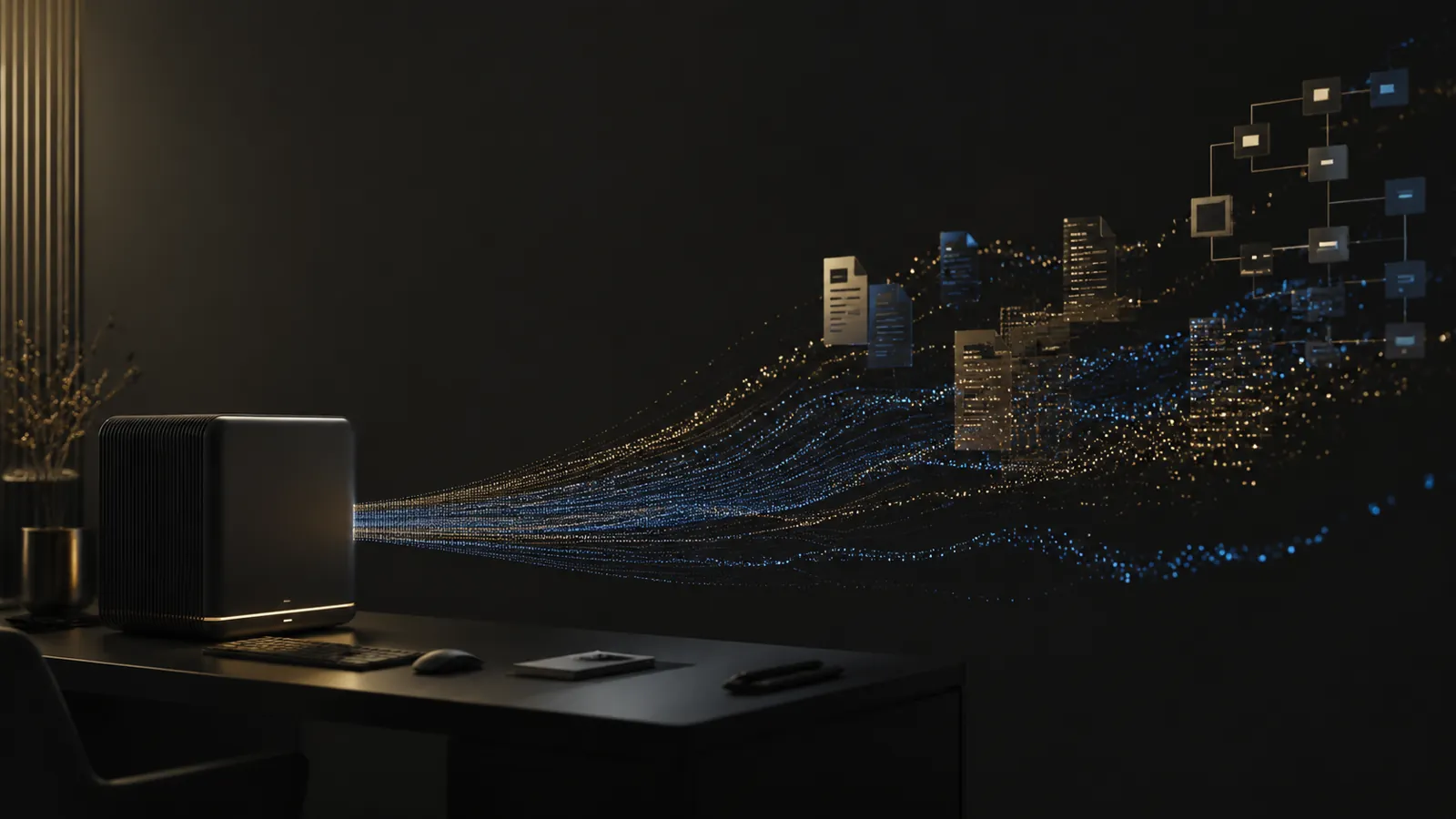
Post-Neumann Architecture.
We didn’t improve the von Neumann bottleneck. We eliminated it — a ground-up rearchitecture of how silicon processes intelligence.
Beyond von Neumann.
Every processor since 1945 has been built on the same assumption: memory and compute are separate. That data highway becomes the primary bottleneck in AI workloads.
Post-Neumann Architecture fuses memory and processing into unified cognitive tiles, where computation happens exactly where data resides — eliminating transit, reducing power, and unlocking deterministic inference.
- No data bus bottleneck — compute co-located with storage.
- Deterministic execution — predictable latency per token.
- Dedicated processing with zero GPU conflict.
- Native transformer support — attention mechanisms in silicon.
Memory-Process Coupled Execution.
In conventional architectures, data travels from DRAM to cache to registers before processing. Each hop adds latency and burns power. MPCE eliminates every hop.
Each AI-SRAM tile contains both storage and arithmetic logic in the same physical structure. Data never moves — instructions come to the data, not the other way around.
- Zero cache misses — data is always local to compute.
- 40–60% power reduction vs traditional data movement.
- Massive parallelism — every tile operates independently.
- Linear scaling — add tiles, add performance.
AI-SRAM tile.
The fundamental unit of Post-Neumann computing. Each tile is a self-contained processing-and-storage element that handles a slice of the neural network without external dependencies.
Unlike GPU cores that share global memory through complex hierarchies, AI-SRAM tiles operate on local data with guaranteed access times — making inference fully deterministic.
- Integrated SRAM + ALU in a single tile structure.
- Deterministic access — no cache hierarchy, no misses.
- Optimized for attention-head computation.
- Tile-to-tile communication via dedicated mesh network.
State capsules.
Current AI inference is stateless — every request starts from scratch. State Capsules introduce persistent, hardware-managed inference state that survives across sessions and requests.
Think of it as hardware-level memory for AI models. The processor maintains context, attention state, and intermediate computations natively — enabling truly contextual, continuous inference.
- Persistent inference context across sessions.
- Hardware-managed state — no software overhead.
- Encapsulated and isolated — secure by design.
- Enables continuous learning at the edge.
ZLTA-2: zero-latency token architecture.
ZLTA-2 is a proprietary inference protocol that achieves sub-0.1ms token generation through predictive token dispatch, speculative execution, and hardware-accelerated attention.
Where traditional pipelines process tokens sequentially, ZLTA-2 predicts the next computational path and pre-stages data before the current token completes — eliminating pipeline stalls.
- Predictive token dispatch — pre-stage next computation.
- Speculative execution with zero-cost rollback.
- Sub-0.1ms per token at production quality.
- Hardware-accelerated attention scoring.
From architecture to silicon.
The patents portfolio shows how the stack is protected. The research lab shows where it’s heading next.